
I hear you. It’s been a long, demanding day at work. You walk through the door and immediately shift into parent mode, homework needs attention, dinner must be made, baths run and tomorrow prepped. Deep down, all you really want is to crawl into bed with a good book and drift off early. But instead, little voices are incessantly calling out “mommy”, and tiny hands tugging at you for your time and energy. You’re running on empty. And before you know it, frustration takes over, you snap, maybe say something harsh, or react in a way you regret. Then comes the guilt, and a wave of overwhelm.
Sound familiar?
Pause and breathe. Keep reading.
In our meetings you will discover how non-violent communication can help parents model emotional regulation, foster healthy expression, and prevent anger from impacting children.
Non-violent communication: Building peace at home through words
The way we speak becomes the world our children live in
Words carry weight. The way we communicate as parents doesn’t just shape our children’s day, it shapes their identity, their behavior, and even their future relationships. Non-violent communication (NVC), a concept developed by psychologist Marshall Rosenberg, is not just about avoiding harsh language; it’s about fostering empathy, clarity, and compassion in every interaction.
When parents are stressed, tired, or overwhelmed, it’s easy to snap, raise voices, or speak harshly. But these moments don’t go unnoticed. Children absorb the tone and energy in the home and often internalise it. What they see becomes what they do.
Why non-violent communication matters
Non-violent communication teaches us to focus on four essential components:
- Observation: Clearly stating what is happening without judgment or blame.
- Feelings: Expressing emotions instead of masking them with accusations.
- Needs: Identifying unmet needs that fuel the feelings.
- Requests: Making clear, respectful requests instead of demands.
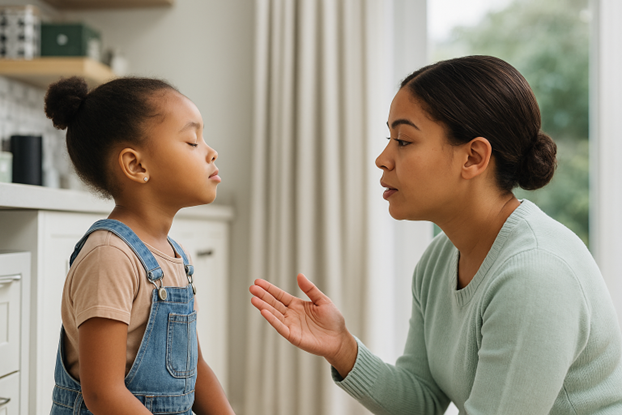
For example, instead of shouting, “You never listen to me!” a non-violent response might be, “When I see you not putting away your toys, I feel frustrated because I need help keeping our space clean. Could you please put them away now?”
Remember how you deliver the message and the tone that accompanies it are what your child hears.
This model helps parents communicate more clearly and lovingly, even in moments of frustration. It encourages emotional intelligence and helps children feel seen and heard, instead of shamed or silenced.
The parent as the emotional role model
Children learn emotional regulation by watching the adults around them. If a parent responds to stress with yelling or harsh discipline, a child may learn to express their own frustration through aggression. This doesn’t just stay in the home, it extends to friendships, school environments, and later in life, romantic or professional relationships.
According to the American Psychological Association, children who witness regular emotional outbursts or aggressive communication are more likely to struggle with anxiety, behavior problems, and even physical health issues over time.
Peaceful parenting starts with inner work. Parents who take responsibility for their own emotional triggers can model calm responses, set healthy boundaries, and help children learn to use words to solve problems.
Encouraging your child to express themselves
Creating a home environment where feelings are discussed openly, without fear of punishment or ridicule, empowers children to communicate more honestly. It also fosters deeper connection and trust between parent and child.
Here are a few ways to encourage your child to use words, not actions:
- Name feelings often. “You seem really sad that we’re leaving the park. It’s hard to stop when you’re having fun.”
- Praise communication. “I love how you told me you were upset instead of hitting.”
- Stay calm and curious. When a child acts out, try to discover the unmet need behind it rather than reacting with punishment.
A peaceful home creates a peaceful world
Raising emotionally intelligent children starts at home. When parents choose non-violent communication, they’re not just improving their own relationships, they’re helping raise future adults who know how to speak with kindness, listen with empathy, and resolve conflict without aggression.
Violence in the home, whether verbal or physical, ripples out into communities and the world. But so does compassion. So does calm. So does the simple act of choosing to speak with love, even when it’s hard.
Your actions ripple outward. Your stability becomes part of the scaffolding that holds up your children.
And that’s why, even when you feel like collapsing, there are times you simply have to dig deep, steady yourself, and carry on. Not because you feel strong, but because those little being who depend on you are standing because you haven’t fallen.
Because I understand the challenges that parents face, I am here to equip you with tools and techniques that have been tried and tested over many years.
Let’s talk about it
If you’ve found this topic meaningful and want to explore how to apply it in your own family, I invite you to schedule a free, no-obligation 30-minute online meeting with me. We’ll look at how peaceful parenting tools, including non-violent communication, can bring calmness and connection into your home.
Let’s work together to raise kind, expressive, emotionally intelligent children.
Find out about my 12 x 60-minute Peaceful Parenting Package Program today.
Citations:
- Marshall B. Rosenberg, Nonviolent Communication: A Language of Life
👉 https://www.cnvc.org/training/resource/book-nonviolent-communication-language-life
This link is from the Center for Nonviolent Communication (CNVC)—the official organisation founded by Rosenberg. It provides information about the book, purchase options, and related training resources.
- American Psychological Association. https://www.apa.org/topics/parenting
- Harvard Health Publishing. Teaching children how to recognize and express emotions
https://www.health.harvard.edu/blog/teaching-kids-how-to-express-emotions-2019040116309