Disenfranchised Grief & Pet Loss: How I Help Parents Support Their Kids
A Gentle Truth: Pets Aren’t “Replaceable”—And Feelings Aren’t Problems
In my coaching work, parents often ask, “Should we get another pet right away?” I always start here: we don’t “replace” family. Pets aren’t disposable; they’re loved companions whose loss deserves time, words, and ritual. Framing grief as meaningful (not something to rush past) teaches children that love, and sadness can coexist,and that their bond mattered. When a new pet is considered, we talk about it as a new relationship, not a substitute, and only after the family has had room to mourn.
What Is “Disenfranchised Grief”?
Disenfranchised grief is grief that isn’t fully recognized or supported by others, like when a pet dies and well-meaning people say, “You’ll be fine; we’ll get another.” Children can feel unseen or even ashamed of their sadness when adults minimize it. The term was coined by grief expert Dr. Kenneth Doka to describe losses that are not socially sanctioned or openly mourned. The term is not only used for pet loss, but for relationships less acknowledged by society too.
Why this matters: a child’s first encounter with death is often a family pet. If we validate their grief and create space for mourning, we’re teaching lifelong coping skills.
Irrespective of the loss one encounters, the void and intensity of sadness may feel much the same. That doesn’t marginalise the love has for a grandparent for example, as opposed to a pet. We may love many people and many animals in different ways. As each being is unique, so too is our relationship with them.
How Kids Understand Death (And What They Need), Age by Age
- Toddlers & preschoolers: Often see death as temporary. Expect repeated questions and concrete thinking. Avoid euphemisms like “put to sleep,” which can create anxiety. Use simple, direct language: “Her body stopped working; she doesn’t feel pain.”
- Primary school: Begin to grasp permanence but may struggle with guilt or “magical thinking” (“Did my wish cause this?”). Reassure clearly: “Nothing you did, said, or thought caused our pet to die.”
- Tweens & teens: Understand death abstractly but may under-share or withdraw. Normalize mixed reactions and co-create healthy coping plans (movement, journaling, time with friends, limited doom-scrolling).
What Grief Can Look Like in Children
Beyond tears, grief may show up as clinginess, regression (e.g., sleep setbacks), headaches or stomach aches, irritability, or concentration dips. These are common, especially in younger children. Track patterns gently and keep routines steady, they ground the nervous system.
What To Say (And Not to Say)
Do say (and model):
- “It’s okay to cry. I feel sad too.”
- “You’re feeling angry and lonely, and both make sense.”
- “Let’s remember funny stories about [pet’s name].”
Avoid: “Be brave,” “At least…,” or rushing to fix feelings. Kids take their cue from our calm presence more than perfect words.
Simple Rituals That Help Kids Heal
Rituals make grief tangible and safe. Consider:
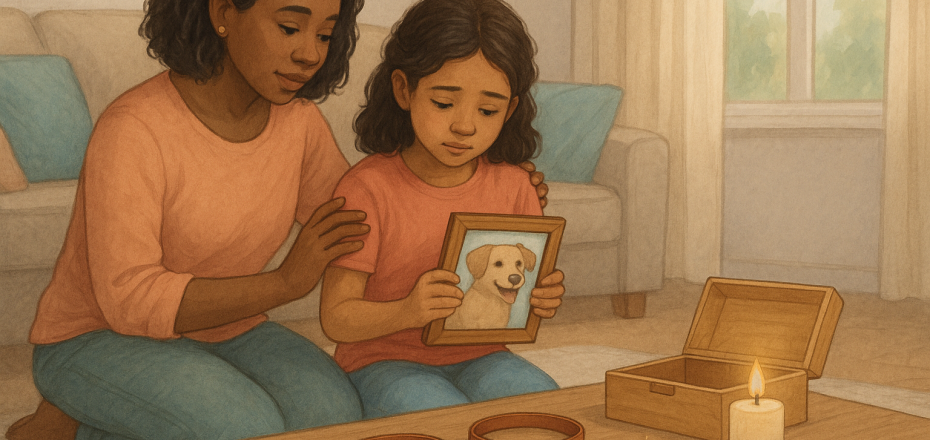
- Goodbye ritual: A candle-lighting, writing letters to your pet, planting a tree, or creating a small backyard ceremony.
- Memory making: A photo book, clay paw print, “favorite stories” jar, or a donation/volunteer day in your pet’s honor.
These acts validate love, create closure, and give siblings shared language for loss.
Answering The Big Questions (Scripts You Can Borrow)
- “What happened to….” “Her body stopped working and can’t start again. She can’t feel pain anymore. We can keep loving her in our hearts and in our memories.”
- “Is it my fault?” “No. Nothing you did, said, or thought caused this.” (Repeat as needed as guilt can resurface.)
- “Can I see her?” / “Should I be there?” Offer choice with gentle preparation; some children want to participate in a memorial or see the body, others don’t. Follow their lead.
Should We Get Another Pet—and When?
A new pet can be a wonderful future chapter, but timing matters. Children may expect a “clone” of the pet they lost or feel pressured to move on. Treat a future pet as a new adventure, not a fix for grief. Wait until your child shows genuine interest and you’ve celebrated your pet’s life with a memorial. Remember though, that grief is not linear. There will be bad days, and better days, and triggers that may take one back to the feelings first felt. Allow the process without a timeline placed upon it.
Red Flags: When To Reach Out for Extra Support
Contact your pediatrician or a child-focused mental health professional if you notice persistent sleep problems, prolonged withdrawal, risk-taking, substance use, or signs of depression/anxiety that don’t ease with time. In an acute mental-health crisis or if a child talks about suicide, call or text 988 in the U.S. for 24/7 help.
Quick Checklist for Parents
- Acknowledge and name feelings; avoid minimizing.
- Keep routines steady (meals, sleep, school).
- Offer choices about participation in rituals.
- Share your own feelings and coping (modeling matters).
- Inform teachers/caregivers so they can respond with empathy.
Let’s Navigate This Together
If your family is grieving a pet, I can help you plan a loving ritual, find the right words for tough questions, and support siblings who mourn differently. Book a free, no-obligation 30-minute online meeting. Ask about my 12 × 60-minute Peaceful Parenting Package Program for step-by-step support.
Further Reading & Resources (For Parents)
- American Academy of Pediatrics — When a Pet Dies: How to Help Your Child Cope. HealthyChildren.org
- American Academy of Pediatrics — How Children Understand Death: What to Say. HealthyChildren.org
- UC Davis Veterinary Hospital — Helping Children Understand Pet Loss (Do’s & Don’ts). vetmed.ucdavis.edu
- Association for Pet Loss and Bereavement — Children & Grief (education and online support). aplb.org
- AVMA Pet Loss — grief overview and printable brochure. AVMA